

Healthcare AI, data and FHIR integration
Put the data you already hold to work: interoperability, evidence pipelines and AI features that are explainable and safe to ship.
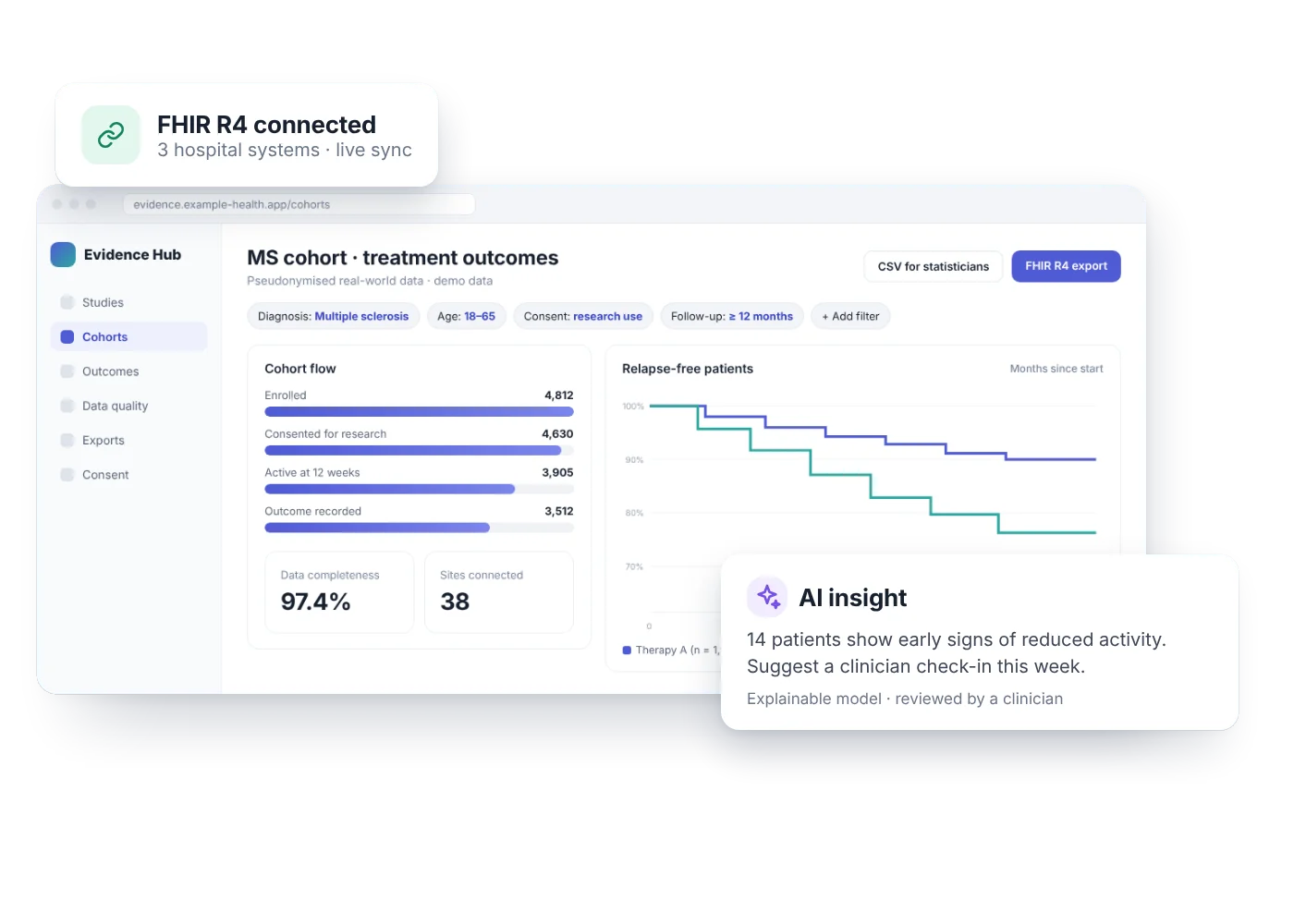
What is HL7 FHIR integration?
HL7 FHIR is the standard health systems use to exchange data such as patients, observations and appointments through web APIs. FHIR integration means modelling your product's data as FHIR resources and connecting to other systems, such as NHS services through FHIR UK Core or the German ePA, without custom one-off interfaces.
- Reply within two working days
- NDA available before you share details
What's included and what you get
What's included
- Data modelling and pipelines
- HL7 FHIR and FHIR UK Core integration
- Machine learning and LLM features
- Dashboards and reporting
What you get
- Reliable, documented data flows
- Models with clear limits and monitoring
- A privacy review of every data use
- Reports your team can run themselves
How is AI and data work priced?
Data and AI work usually starts with a fixed-price assessment of your data sources, quality and privacy constraints, then continues as a project or within a dedicated team. The cost depends on the number of integrations, data volume and whether models need clinical validation. You get a written estimate first.
- Fixed scopePrice agreed before work starts
- Dedicated teamMonthly, per team member
- SupportMonthly retainer, agreed response times

Rewoso: a real-world evidence platform
Real-world evidence tooling, a DiGA Manager for manufacturers and treatment modelling for multiple sclerosis.
Our process and what you get
Data assessment
Sources, quality and gaps.
Privacy review
Legal basis and data minimisation.
Build
Pipelines, FHIR interfaces and models.
Validate
Limits, monitoring and sign-off.
Handover
Documentation and self-serve reports.
AI and data integration questions
How do you make AI features safe in healthcare?
We use AI where it saves real time, keep a person in the loop for clinical decisions, log inputs and outputs, test against known limits, and review every data use for privacy.
Will an AI feature make our product a medical device?
It can, depending on its intended purpose. That decision belongs with you and your regulatory advisors; we help you understand what each answer means for the software.
Do you send patient data to external AI providers?
Only if you approve it after a privacy review and a data processing agreement is in place. Many features can run on de-identified data or in your own cloud.
What is real-world evidence?
Real-world evidence is insight from data collected during everyday use of a product, rather than in a trial. For a DiGA it helps show the product keeps helping patients.
Can you integrate with the NHS?
Yes. We work with FHIR UK Core, NHS login and NHS APIs where your product needs them, scoped against DTAC.
Which data tools do you use?
PostgreSQL, dbt and Python for pipelines and analytics, PyTorch for machine learning, and large language model APIs with guardrails, confirmed with you in discovery.
Related services and guides
Web platform development
Patient portals, clinician dashboards, admin tools and internal systems, built to be fast, accessible and secure from the start.
See the serviceDedicated teams
A long-term squad of engineers, designers and QA that works inside your roadmap, or specialists who join your in-house team, with the healthcare experience most outsourced teams lack.
See the serviceSupport and modernisation
We review, take over and stabilise existing systems, then modernise them step by step, so the business keeps running while the software improves.
See the serviceNHS DTAC explained
What NHS buyers check before they sign, and the evidence they ask for.
Read the guideTalk to an engineer about AI and data integration
Tell us where your product is today. We will suggest the smallest useful next step.
NDA available before you share details