

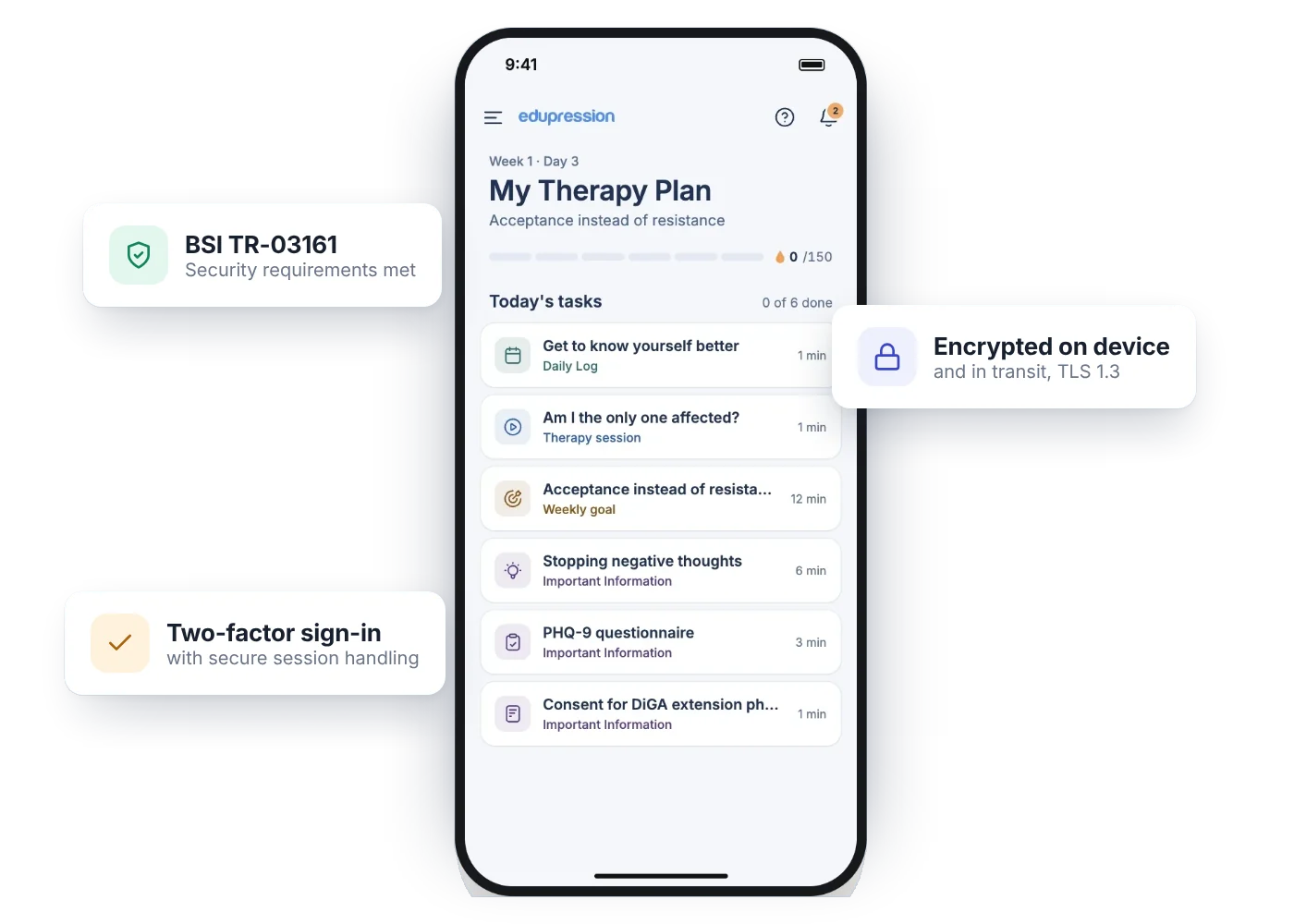
If you are building a digital health application for the German market, security is not something you can add at the end. BSI TR-03161 sets out what "secure enough" means for health apps, and DiGA manufacturers have to prove they meet it. This article explains the guideline in plain language and shares what we learned taking Edupression through its audit.
What the guideline is
TR-03161 is a technical guideline published by the BSI, Germany's Federal Office for Information Security. It describes security requirements for applications in the healthcare sector: how they authenticate users, store and transmit data, handle sessions, log events, and resist common attacks.
For DiGA, meeting these requirements is part of proving information security to BfArM. In practice, that proof is a certificate based on an assessment against the guideline.
The three parts
The guideline is split by the type of component, because a phone app, a website and a server face different risks.
- Part 1: mobile applications. The app on the patient's phone, including local storage, platform security features and communication with the backend.
- Part 2: web applications. Browser-based front ends, such as patient or clinician portals.
- Part 3: background systems. The servers, databases and APIs behind the app.
Most DiGA have at least two of these. Each one in scope needs to meet its part.
How the assessment works
An accredited testing lab evaluates your product against the requirements. It reviews documentation, examines the architecture and tests the running software. Findings have to be fixed and re-checked before certification.
The audit should confirm decisions you already made, not reveal decisions you never made.
Lesson from the Edupression project
How to prepare
Start in discovery
Decide early how users sign in, where data lives, what is stored on the device and how long sessions last. These choices are expensive to change later.
Collect evidence as you build
Keep a living record of security decisions, threat models and test results. When the assessor asks how a requirement is met, you can point to it rather than reconstruct it.
Test like an assessor
Run regular security testing during development, not just once before the audit. Every finding fixed early is one the lab will not find.
We review products against TR-03161 and DiGA requirements and give you a prioritised list of gaps.
Common mistakes
- Treating the audit as a final checkbox and planning no time for fixes
- Forgetting the backend and admin tools, which are in scope too
- Relying on third-party components without checking their security posture
- Documentation that describes the intended system rather than the real one
Sources
- BSI: Federal Office for Information Security, Technical Guideline TR-03161
- BfArM: Federal Institute for Drugs and Medical Devices, DiGA information for manufacturers